

By Liem Nguyen, International Philanthropy Manager, Myriad Australia
Chhaiya Im is the founder of Opening Doors Cambodia (ODC), a local NGO in Siem Reap that provides English education, life skills and character formation to children and young people from families who cannot afford expensive private classes. ODC is now a registered partner of Myriad Australia, so they could enable their existing Australian network a pathway to give with tax deductibility.
In July 2026, Chhaiya will ride 600 kilometres across Cambodia to keep the school’s doors open - so I sat down with him to hear his story.
Watch or listen to the full conversation here.
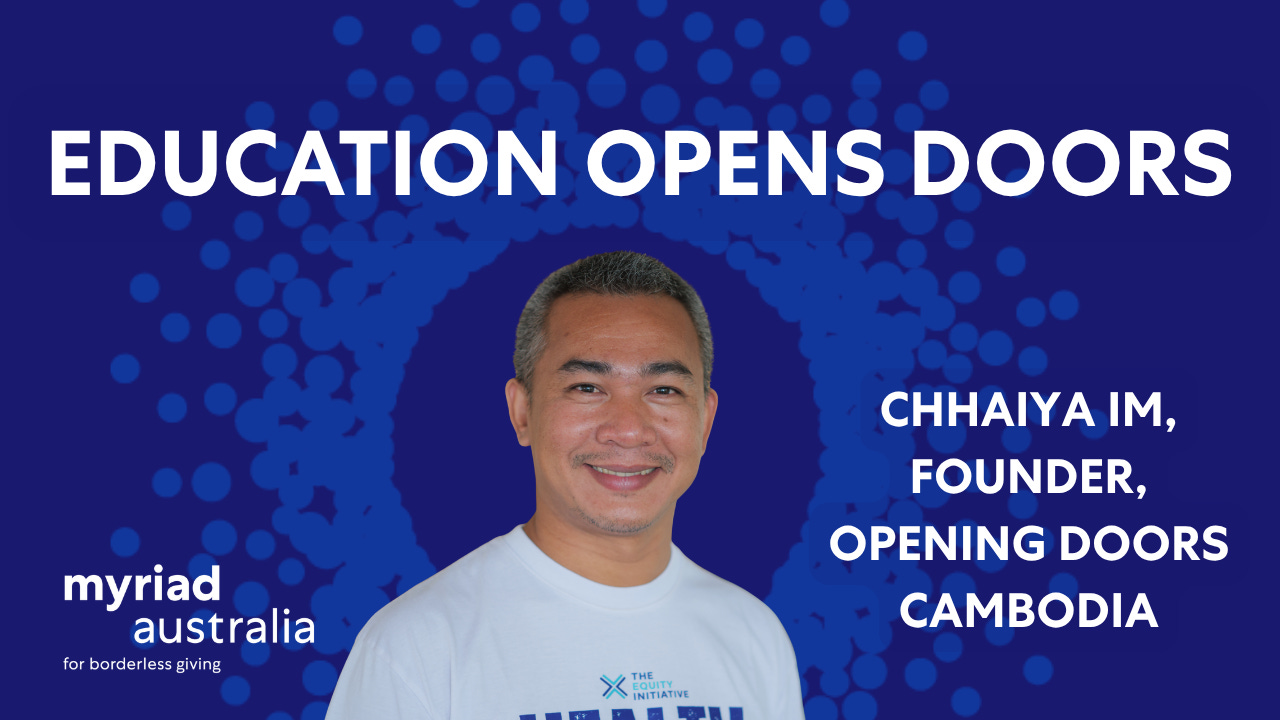
Take us back to the beginning. Why did you start an English school in Cambodia?
Opening Doors Cambodia really began from my own experience. I grew up in Cambodia in a place where poverty was part of everyday life, and as a child I saw very clearly that education was not always fair for everyone.
One experience stayed with me. I was in grade seven at a public school, and before a chemistry exam my teacher asked students to pay for an extra study session. I could not afford to pay, so I did not attend. On exam day, the students who paid sat in one row, and the students who had not paid sat in another row - and we were given different exam papers. At that time I was still young. I did not have the words to explain it as inequality, injustice or corruption, but I knew something was wrong. I remember feeling that children should not be treated differently because of money. That moment stayed very deep in my heart. It was one of the first moments that made me feel something must be done, so the next generation does not have to experience this.
Later, my grandfather told me he had suffered because of his education. He said, “Chhaiya, learn English. It will save you.” At first I did not fully understand what he meant. But one day, when I saw a monk teaching English in a Buddhist monastery in Siem Reap, his words came back to me. I began studying English there in 2008, the year I finished high school.
English really changed my life. Because of English, I got a job as a hotel receptionist after studying for only about half a year in that monastery. That job helped me save money to go to university, and later English helped me become a teacher in 2012. It helped me survive my university years. I studied banking and finance and graduated in 2014, and I worked in the business sector for a short time. The salary was good, but I did not feel fulfilled. I realised my heart was not in business - my calling was in education. I wanted to help children who came from families like mine: children who had ability and hope, but did not have the same access to opportunity.
So in 2015, I started teaching children in my parents’ backyard. It was very small at the beginning. It was not a big organisation - it was just a dream, a few children, and a strong belief that education could change lives. Later, in 2017, I used my own savings and took a bank mortgage to buy land and build a simple learning space, right here where I am sitting now. It was a big risk for me personally. But I believed that if English had opened doors for me, it could also open doors for many Cambodian children.
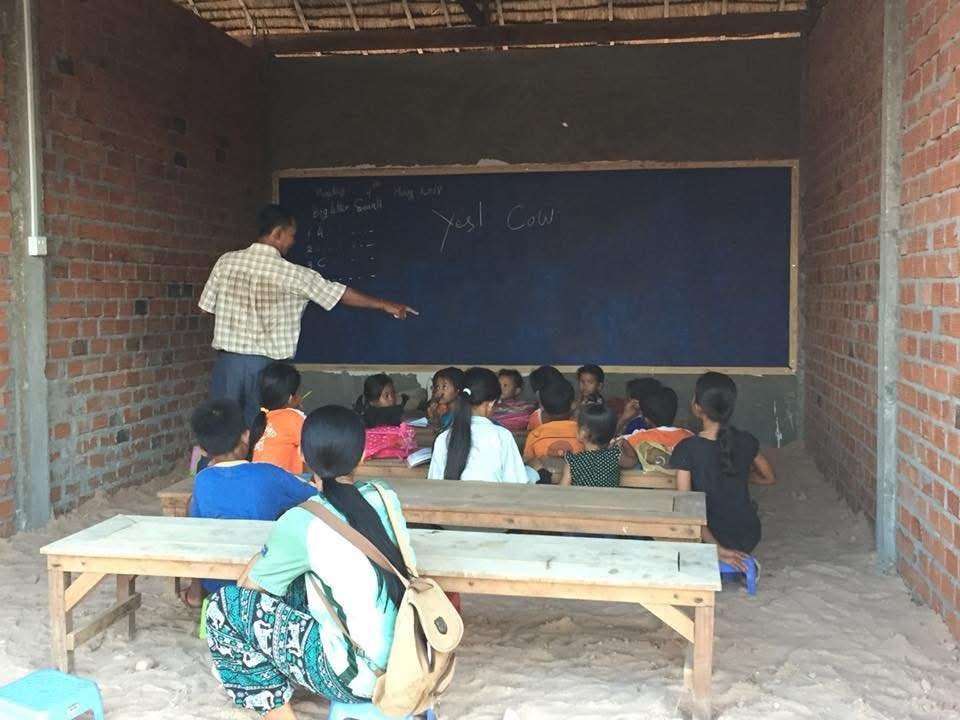
Early English classroom, photo supplied: ODC.
That is why I started ODC. It came from my own pain, my own experience, and my own transformation. I know what educational injustice feels like, and I also know what opportunity can do when one door opens. So my “why” is simple: I believe children should not be limited by poverty, corruption, family background, or lack of access. I believe education should liberate children, not control them. And I believe English can be one key that helps Cambodian children unlock their potential.
ODC is more than an English school. Who do you serve, and what makes it different?
ODC started with just one dream, my own dream, and it has now become an organisation - a responsibility that my team and I have to carry.
We are a local Cambodian NGO based in Siem Reap, and we mainly provide English education to children and young people, especially those from families who could not afford expensive private English classes. Many of our students attend public school, but public school alone is not enough for English. They also need confidence, life skills, discipline, teachers who believe in them, and a safe and serious learning environment. I am not saying I do not trust the public system - what we do at ODC is fill the gap that public school cannot. We make sure children are respected and encouraged to learn.
For us, English is not only a language subject. It is a bridge. In Siem Reap especially, English opens many doors - higher education, scholarships, and tourism. We have Angkor Wat and many other temples that people come to see, so there are hospitality jobs, international communication, and a wider world of knowledge. I know this personally, because English changed my whole life. I want my students to have the same key.
But ODC is not only about teaching English. We use English education to help children grow as whole people. We envision Cambodian children becoming confident future leaders who can give back to their own communities. Our mission is to educate - not to indoctrinate, but to liberate. We have been through so many wars, and I know how Cambodian children have often been treated: most of the time we just do what we are told to do in class, and at home we just do what our parents tell us. At ODC, we make sure they can do what they want, with discipline, love and compassion.
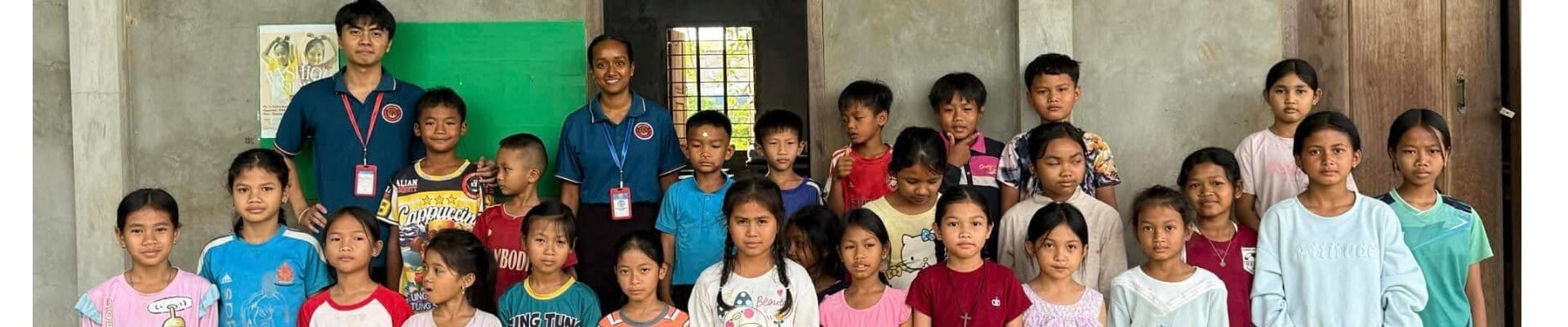
English class and students, photo supplied: ODC.
One part of ODC I am especially proud of is the Teaching Scholars Program. Some students begin as learners, then become teaching scholars - they assist teachers in classrooms and learn essential teaching skills. Some of them later become teachers at ODC. Right now we have two teachers who started as students. They came back to ODC to help their own community, and that is what I wish for. I want ODC in the future to be led by people who first came as students and later became teachers and leaders. My days are counted - I don’t know how much time I have left - but maybe after we have all gone, these people will stand for their own community. To me, that is very powerful. It means ODC is creating a cycle of hope: a child receives an opportunity, grows through it, and then helps give the same opportunity to younger students. When younger students see former students becoming teachers, they can believe, “Maybe I can do that too.”
I do not want people to look at the children we serve only through poverty, as victims. I have seen tourists, supporters and donors come to Cambodia and do a lot of activities, thinking they are helping these children. Of course that kind of action helps. But in the long run, if you simply give things to children, they come to expect things from others and they become dependent. These are capable young people - they have talent, dignity and potential. Many of them simply need an open door, someone to believe in them, and a place where they can learn seriously and safely. For me, ODC is not just a school. It is a response to inequality. It is my way of saying that Cambodian children from ordinary families deserve quality education, dignity, and the chance to build a better future.
ODC is going through a difficult funding season. What happened, and what does the school need right now?
The funding gap at the moment is around US$20,000 (approximately A$28,500). The fundraising goal for the bike ride is around US$50,000 (approximately A$71,000), because if we are able to raise that amount, we can make sure that schooling at ODC is safe for the rest of this year and into 2027.
This year we have only 217 students. The number dropped because our funding was cut at the beginning of the year - last year we had 300 students, and because of the cut we had to reduce to around 200. Right now we also have about 80 students on the waiting list, still hoping for a seat to study at ODC. For one student, we spend approximately US$250 a year (about A$360). Most families where ODC sits now are middle-income, so they can pay a subsidised fee of US$70 (around A$100) rather than the full cost. For those who cannot afford it, we provide scholarships - this year we have 25 scholarship students from families who really cannot pay. Previously we had donations from international individual donors, but this year that funding was cut, so we are working hard to find other income sources to fill the gap.
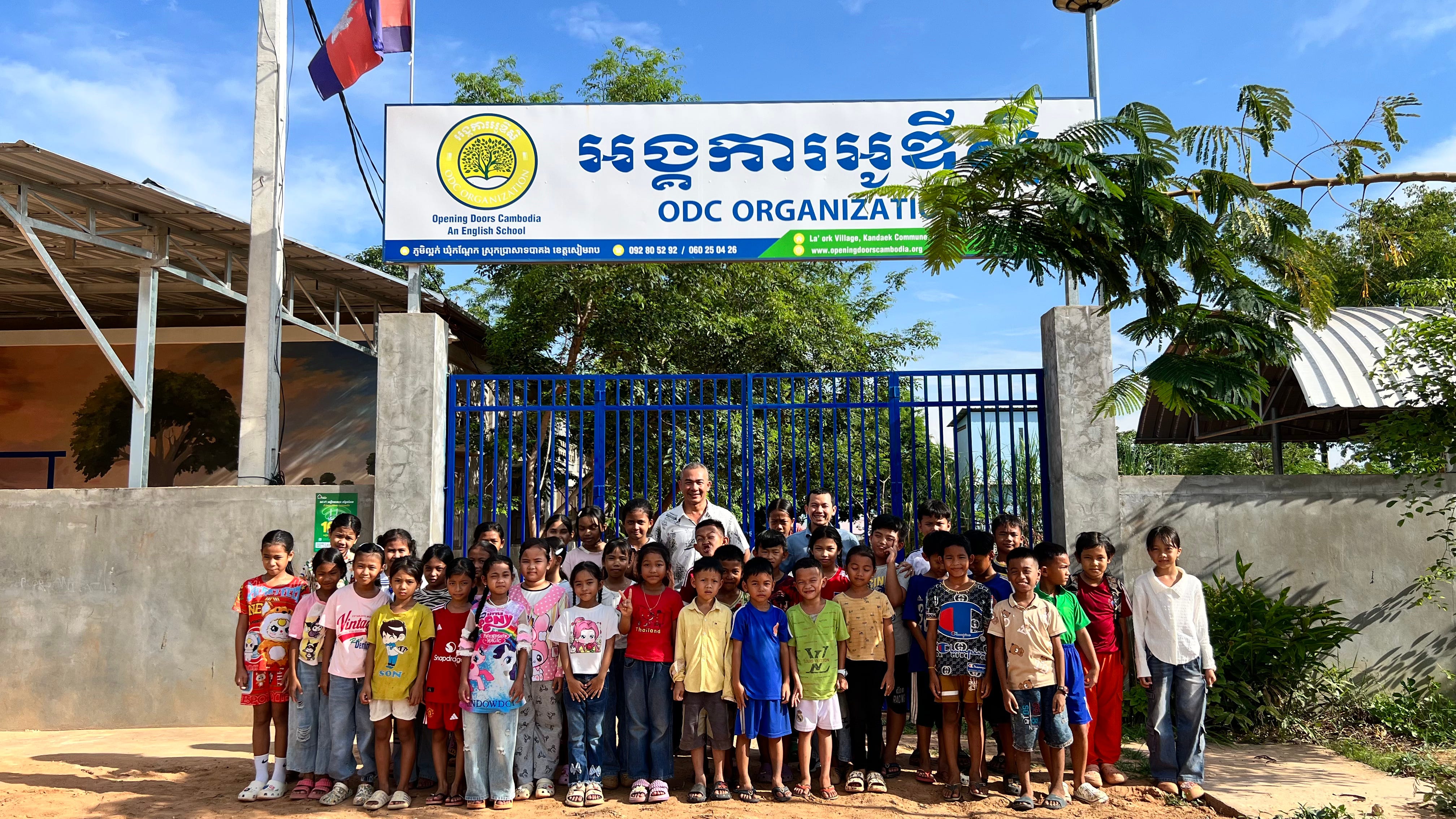
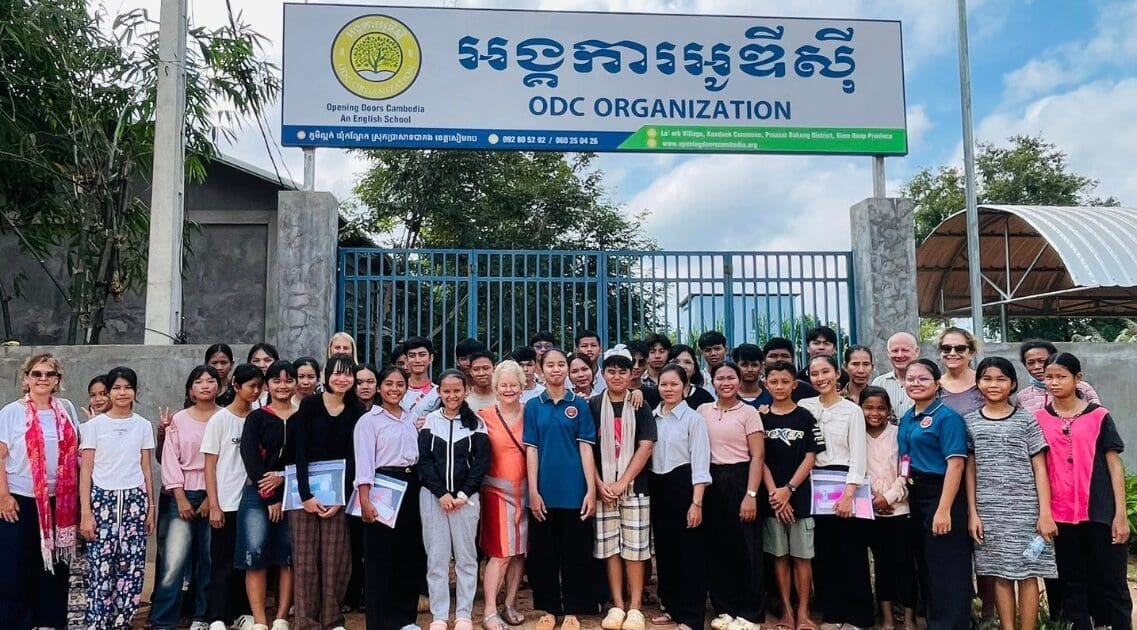
Chhaiya and students in front of the school, photo supplied: ODC.
You’re about to ride 600 kilometres across Cambodia. Why a bike ride, and what do you hope it achieves?
We are planning to start on 25 July, and we will ride 600 kilometres in 10 days - 10 riding days plus two returning days. I am not a cyclist! One of my team will co-lead the ride with me; he is our head of curriculum and part-time fundraiser, and he was the one who raised the idea. I think this is the right time to do it.
This charity bike ride is not only about cycling 600 kilometres across Cambodia. It is my way of carrying the mission with my own body, my own effort, and my own commitment. Right now ODC is facing a difficult funding season, and I do not want to sit quietly and wait for help. I want to act. I want to protect this mission, and I want to invite others to move with us. If I am asking people to believe in ODC, I also want to show that I am willing to carry the weight of that belief myself. Every kilometre is for the students who are still learning, still hoping, and still depending on ODC to keep its doors open.
Many Australians want to help, especially after visiting Cambodia. Where do you think their support is best placed?
I think it depends on trust - the level of trust donors place in a person or an organisation, and in what that organisation actually does. Trust is not easy. Ideally people come on site to see what is really happening, to see that an organisation is genuinely doing the things that meet the students’ needs.
At ODC we are very careful about giving things freely to students, because we are afraid they might take on the mindset that they don’t need to do anything - that they can always get support from other people. So I believe the best place to help is to find out who is really doing the work for Cambodian children: an organisation that does one thing, or a few things, that genuinely help. And I believe - I guarantee - that ODC is one of those organisations that makes sure students’ needs are met. That is what keeps me going.
Opening Doors Cambodia Community, photo supplied: ODC.
Where can English take your students? What does life after ODC look like?
A student comes to ODC as a beginner. They learn phonics and communication, then move to higher levels with more difficult grammar, speaking, writing, reading and listening. We also have an online class, taught by one of our former board members from Perth, Australia. After they graduate from ODC, we strongly believe they can use English first to find jobs in Siem Reap, in the tourism industry. Once they have a job, they can pay for higher education at university, or support their families. Starting from one person, they can secure a better future - and who knows, they might use English as the bridge that connects them from Cambodia to Australia, to England, or to America for their higher education.
I have a student who came to me from the very beginning and is now a teacher at ODC. She once told me she wanted to pursue a master’s degree abroad. She is now in year three at university, studying English Literature. Let’s see if her dream comes true - it started by coming to ODC first as a student. She is already making an impact in her own community. We don’t know how their futures will unfold. Who knows - they go abroad for a master’s degree, then come back as leaders and give back to their own community.
What is your message for the people reading our conversation today?
ODC began as a small dream in my parents’ backyard, but now it has become a responsibility - to the children, to the families, to our teachers, and to Cambodia itself. I do not believe education should belong only to children whose families can pay. I believe education should open doors for every child.
This bicycle ride is my personal way of saying that I am still willing to fight for this mission. I know it will not be easy. It will be long and tiring and hot - it’s rainy season, so we expect a lot of rain along the way. But if I am asking others to believe in ODC, I must act to carry that belief through action.
So to friends, especially in Australia, I would say: please stand with us. Please sponsor this ride through Myriad Australia, or any other way you can. Your support can help us keep education at ODC alive for Cambodian children, and keep opening doors for the next generation.
Opening Doors Cambodia is a registered partner with Myriad Australia. Australian donors can make tax-deductible donations through myriadaustralia.org.
Further Reading
Opening Doors Cambodia: openingdoorscambodia.org
ODC’s “Ride for Education” charity bike ride - details on the ODC Friends Fund page at Myriad Australia